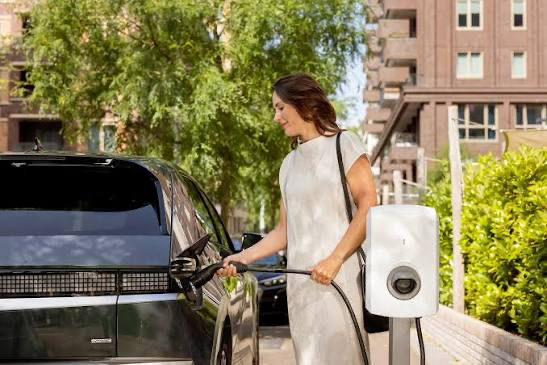
When most people buy an electric vehicle, they focus on range, acceleration, and how long the battery lasts on long road trips. But once the excitement of driving off the lot fades, the reality of EV ownership shifts to a much more immediate place: the home driveway.
Because more than 80% of EV charging happens at home, plugging a high-powered vehicle into a standard residential electric system changes how a household uses electricity. A typical Level 2 home charger draws 40 to 48 amps of current—matching or exceeding the demand of an electric furnace or central air conditioner.
This dramatic rise in power demand is fundamentally changing home energy management, prompting homeowners to upgrade electrical panels, explore smart load controllers, and optimize local power setups.
The Installation Bottleneck: Level 1 vs. Level 2 Charging
Most electric vehicles come with a standard Level 1 charging cord that plugs directly into a standard 120-volt wall outlet. While convenient, it only adds about 3 to 5 miles of driving range per hour. Fully recharging a large EV battery this way can take upwards of 40 hours.
To get practical overnight charging, most drivers upgrade to a Level 2 setup, which uses a 240-volt circuit and provides 25 to 35 miles of range per hour. However, stepping up to Level 2 often reveals hidden challenges in a home’s electrical setup.
- The 100-Amp Panel Bottleneck: Older single-family homes often have a 100-amp main electrical panel. Adding a dedicated 50-amp or 60-amp circuit just for a charger can easily overload the panel, making an upgrade to a 200-amp service necessary.
- Upfront Upgrade Costs: While the charger hardware itself usually costs between $350 and $700, professional installation, permit fees, and electrical upgrades typically push total costs between $1,200 and $3,000.
- Smart Load Management: To skip expensive panel upgrades, many homeowners opt for smart load-sharing switches. These devices monitor real-time power draw and automatically pause or dial back EV charging whenever heavy appliances—like an electric dryer or oven—turn on.
| Charging Level | Voltage & Connection | Charging Speed | Ideal Use Case | Installation Impact |
| Level 1 | 120V Standard Outlet | ~3 to 5 miles/hr | Low daily mileage, plug-in hybrids | Zero installation; low grid impact |
| Level 2 | 240V Dedicated Circuit | ~25 to 35 miles/hr | Daily commuting, full battery EVs | Often requires panel work or smart switches |
From Basic Chargers to Home Energy Management Systems (HEMS)
As power utilities transition to Time-of-Use (TOU) electricity pricing, plugging in an EV during peak late-afternoon hours can cost three to four times more than charging late at night. This cost difference has pushed homeowners away from basic “dumb” wall chargers and toward integrated Home Energy Management Systems (HEMS).
A HEMS acts as the brain of a home’s electrical setup, coordinating software to schedule charging automatically when utility rates are lowest:
| System Component | Role in Energy Flow | Connection Type & Direction |
| Rooftop Solar Array | Generates renewable solar power | One-way input → Inverter / HEMS |
| Electric Vehicle Battery Storage | Stores energy & supplies backup power | Two-way exchange ↔ Inverter / HEMS (Bi-Directional) |
| Home Main Panel / Critical Loads Hub | Distributes electricity to household appliances | Two-way exchange ↔ Inverter / HEMS (Bi-Directional) |
| Local Utility Grid | Imports grid electricity & exports surplus energy | Two-way exchange ↔ Inverter / HEMS |
| Bi-Directional Inverter / HEMS | Central hub managing power routing, V2H, and TOU optimization | Connects and controls all four energy sources/loads |
By connecting an EV charger with rooftop solar panels and home storage batteries, software routes excess solar generation straight into the vehicle during the day, cutting grid reliance to a minimum.
Vehicle-to-Home (V2H): Turning Cars into Backup Power
The newest frontier in residential energy is Vehicle-to-Home (V2H) bi-directional charging. An average EV battery pack stores between 60 kWh and 130 kWh of energy—enough electricity to power a standard American home for several days during a blackout.
With standardized hardware and bi-directional inverters becoming widely available, V2H is moving from an experimental idea to a reliable home backup option. Rather than buying a standalone gas generator, homeowners can use their vehicle as a mobile energy reserve that keeps essential appliances running when the main power grid goes dark.
The Driveway as an Energy Hub
Adding an electric vehicle to a household is about far more than changing how you commute. It frequently serves as the gateway to wider home upgrades—sparking electrical modernizations, solar installations, and dynamic energy management.
By taking a proactive approach to home energy infrastructure, homeowners can reduce utility costs, increase energy independence, and build a more resilient domestic power setup for the future.